
How to Turn One Happy Customer Into Three New Leads
How to Turn One Happy Customer Into Three New Leads
How to Turn One Happy Customer Into Three New Leads
A practical guide to turning satisfied customers, Chamber connections, and everyday conversations into a steady stream of warm referrals.
Referral marketing works best when it feels natural, timely, and easy to act on. Your happiest customers may already be talking about you to neighbors, friends, and colleagues—but without a clear system, many of those opportunities disappear before they ever reach you.
That is why referral marketing should not be left to chance. For many small businesses, it deserves a place alongside your core marketing goals—because the most effective leads often come from someone else’s confidence in what you do.
Why referrals matter
Referrals carry built-in trust. A stranger clicking an ad may be curious, but a customer recommending your business to a friend is handing you a warm lead. That is worth building a simple system around.
You do not need a huge budget or a complicated referral program. What you need are a few repeatable habits that make it easy for happy customers to send more people your way.
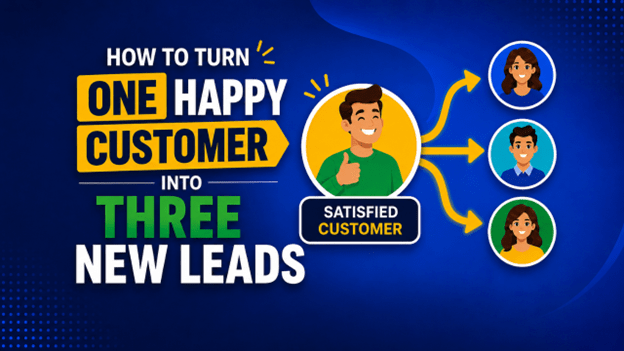
One happy customer is not just a success story—it can become the starting point for your next wave of leads.
Ask at the Right Moment
Start by knowing when to ask. Timing matters. The best moment is usually right after a customer has had a positive experience. Maybe they compliment your team. Maybe they leave a great review. Maybe they reorder, renew, rebook, or tell you how much something helped them.
That is your opening.
Try language that is clear and direct. Instead of saying, “Let us know if you know anyone,” which puts all the work on them, be specific.
“If you know another business owner who could use help with this, I’d be grateful if you’d send them my way.”
Or:
“We love working with customers like you. If you have a friend or colleague who needs this, feel free to share our contact info.”
Specificity helps people think of someone.
Or tell them the why you need referrals. People are more likely to help when you tell them why you need it.
“We’re a small business and we get most of our clients through referrals. We would appreciate you telling your friends and family about us.” This helps them understand how important referrals are to you, but it also tells them that many people have referred you (“We get most of our clients through referrals.”)—that’s social proof.
Make Referrals Easy to Share
Next, make referrals easy to share. Create a short blurb that customers can forward by text or email. Keep it conversational.
For example:
“I’ve been working with [Business Name], and they’ve been great. They help with [specific service/product], and I thought of you because [reason]. Here’s their info.”
You can also create a simple referral card, QR code, or web page with your contact information, top services, and a clear explanation of who you help. If someone has to hunt for your phone number, website, or booking link, you’re making them work too hard and few people will do that.
Turn Conversations into Warm Introductions
Another quick win is to ask for introductions in person, especially at events. If a customer, vendor, or fellow business owner says they know someone you should meet, ask whether they’d be comfortable making the connection. A warm introduction is stronger than a cold email. It gives the other person context and makes the conversation feel less transactional.
This is where your chamber can become a practical business development tool. Chamber events aren’t only for showing up, shaking hands, and collecting business cards you’ll later find in your purse, car, or desk drawer like tiny rectangles of guilt. Used well, they can help you build a smarter referral network.
Use the Chamber as a Connection Partner
Before attending an event, think about who you want to meet. Are you hoping to connect with real estate professionals, restaurant owners, nonprofit leaders, healthcare providers, employers, young professionals, or city leaders?
Reach out to the chamber and ask which events tend to attract those groups. Many chambers know the personality and audience of each gathering. A morning coffee may draw a different crowd than a women’s leadership event, an industry roundtable, a ribbon cutting, or a large signature event.
Your chamber may also be able to make direct introductions. If you’re looking to meet a certain demographic, ask. That’s part of the relationship-building advantage of membership. Chamber staff often know who’s growing, who’s hiring, who’s collaborating, who’s new to the community, and who might be a strong connection for your business.
Follow Up Before the Lead Goes Cold
Once you make a connection, follow up quickly. Within 24 to 48 hours, send a short note. Mention where you met, reference something specific from the conversation, and suggest a next step if it makes sense. Don’t overcomplicate it.
A good follow-up might be:
“It was great meeting you at the chamber event yesterday. I enjoyed hearing about your expansion plans. If you ever need help with [specific need], I’d be happy to be a resource.”
Track What’s Working
Finally, keep track of referrals. A simple spreadsheet or notes field in your CRM is enough. Track who referred whom, when you followed up, and whether the connection became a customer. This helps you thank people properly and see which relationships are generating real business.
The best referral strategy isn’t pushy. It’s prepared and focused. You’re making it easier for people who already trust you to open the next door.
Referral playbook: Keep the process simple, visible, and easy to repeat.
- Ask right after a positive experience.
- Equip customers with words and contact details they can easily share.
- Request warm introductions when opportunities come up.
- Follow up within 24 to 48 hours.
- Track every referral source so you know what is working.
Take the Next Step
Look at the chamber calendar and see what’s coming up next. Then reach out to the chamber before you attend. Let them know who you’re hoping to meet.
The right event, the right introduction, and one happy customer can turn into your next three leads.