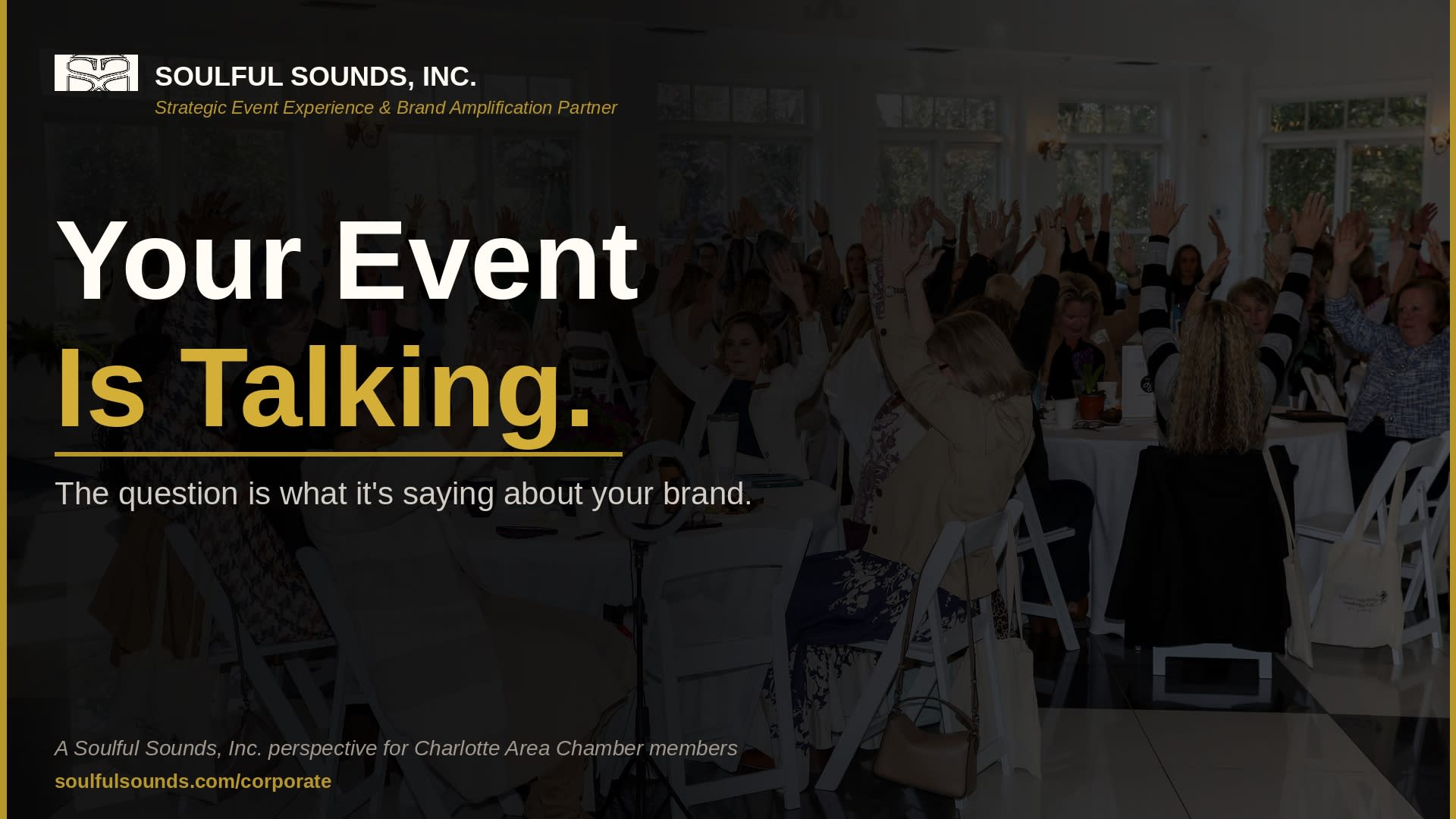
Your Event Is Talking. The Question Is What It's Saying.
Your Event Is Talking. The Question Is What It's Saying.
By Dr. Angel Taylor, BSN, RN | Chief Operations Officer, Soulful Sounds, Inc.
You spend months planning your annual conference. You book the venue, confirm the caterer, finalize the agenda, and send the invitations. Your team is ready. Your speakers are prepared. And then the day arrives, AND the microphone cuts out during the opening remarks. The presentation slides don't advance. The room feels flat. People are checking their phones before the first session ends.
Nobody says anything. They smile, shake hands, and head for the exit.
But they noticed.
Your Event Is a Brand Statement
Every gathering your company hosts, a boardroom presentation, a client appreciation dinner, a leadership summit, a holiday celebration, is communicating something about who you are as an organization.
Think about the last event you attended that left an impression. Not the agenda. Not the buffet. The feeling. The way the room was set. The way the energy moved from the moment you walked in. The way the program flowed without a single awkward pause. That feeling was not an accident. It was a decision, made by someone who understood that the atmosphere of a room is as much a part of your brand as your logo or your elevator pitch.
Now think about the last event you attended that felt like it was held together with tape and optimism. Feedback squealing through a microphone. A presenter fumbling with cables. A program that ran forty minutes long because nobody managed the transitions. You probably do not remember what was said. But you remember how it felt, and you formed a quiet opinion about the organization behind it.
That opinion is your brand.
The Business Cost of a Bad Event
In Charlotte's corporate landscape, relationships are currency. The Charlotte Area Chamber of Commerce exists because we understand that who you know, and how you show up in front of the people you know, determines the trajectory of your business.
A poorly produced event does not just leave a bad impression. It creates doubt. It signals to your clients, your partners, and your prospects that your organization does not sweat the details, and if you do not sweat the details at your own event, why would they trust you to sweat the details in business?
The reverse is equally true.
A well-produced event tells a story without saying a word. It says your organization is intentional. It says you respect the time of the people in that room. It says you understand that every touchpoint is an opportunity to reinforce what you stand for. In a market as competitive and relationship-driven as Charlotte, that story is worth more than any advertisement you will ever run.
What "Good Production" Actually Means
There is a misconception that professional event production is a luxury reserved for Fortune 500 companies with unlimited budgets. That is simply not true, and it is one of the most expensive misconceptions a small or mid-size business can hold.
Professional event production does not mean excess. It means intentionality. It means someone is managing the sound so your presenter is heard clearly in every corner of the room. It means the transitions between program segments are smooth enough that your audience stays engaged rather than drifting. It means the energy in the room is being actively managed, not left to chance.
It means that when something goes wrong, which it always can, someone is already handling it before your guests notice.
That level of preparation is available to businesses of every size. And the return on that investment shows up in ways that are hard to measure but impossible to ignore: the client who mentions your event months later, the partner who brings a referral because they felt valued in your space, the team that walks away from your retreat actually energized instead of exhausted.
Three Questions Every Business Should Ask Before Their Next Event
1. What do we want people to feel when they walk in? Not what do we want them to hear, or learn, or eat. How do we want them to feel? Start there and build backward. Every decision, the music, the lighting, the flow of the program, should serve that emotional intention.
2. Who is managing the experience? Every event needs someone whose only job is the experience itself. Not the agenda. Not the guest list. Not the catering order. The experience. If that person does not exist, the experience belongs to chance.
3. What will they remember? People do not remember what you said. They remember how you made them feel. Plan accordingly.
A Note on Charlotte
We are in one of the fastest-growing business cities in the country. Charlotte is attracting corporate headquarters, national conferences, and high-profile events at a pace that shows no signs of slowing. That growth creates extraordinary opportunity for every business in this Chamber, but it also raises the bar.
The organizations that will win in this market are not necessarily the ones with the biggest budgets. They are the ones that understand how to create connection. How to make people feel something in a room. How to build relationships that last beyond the event itself.
That is not a production problem. It is a strategy problem, and strategy is where we all have to start.
Soulful Sounds, Inc. is a Charlotte-based, MWSBE-certified strategic event experience and brand amplification company serving corporate organizations, nonprofits, and celebrations across the nation. With more than 25 years of execution leadership, we have had the privilege of producing events for organizations including Google, Amazon, Coca-Cola, Bank of America, Siemens, and Aveda.
If you would like to talk about what your next event could be, not just what it should include, but what it should feel like, we would love that conversation.
Dr. Angel Taylor, BSN, RN Chief Operations Officer, Corporate Division Soulful Sounds, Inc. ATaylor@soulfulsounds.com | 980-222-1119 www.soulfulsounds.com/corporatebrochure
Images