Running the real costs of an Eviction for a Charlotte Landlord

Running the real costs of an Eviction for a Charlotte Landlord
As a property manager, I speak to A LOT of Owners every day, in all different aspects of their real estate journey. More often, here lately, the conversations swirl around tenants not paying rent and what the real costs are of getting the tenant out. We ran real numbers, from the county docket and from our own properties when we go through this process, and felt Owners should know it’s MORE than just filing fees and lock changes.
The filing fee is $96. I wish that were the cost. Here is the real one. One thing up front: I am a licensed broker and a property manager, not an attorney. Everything here is what the statutes say and what I have lived through filing in this county. It is not legal advice, and if you are in the middle of one of these, call a landlord-tenant attorney.
The real numbers of an eviction can be daunting to some Owners. You can plug some numbers into a spreadsheet and get a partial answer. Then there are some costs that never show up on the invoice. This is the part I actually wanted to talk about. Not the filing fees. The lost rent, turnover, time, and most important, opportunity costs.
Lost rent. The average lease in Mecklenburg County over the twelve months ending May 2026 was $2,203 a month (Canopy MLS). Two months of the timeline below is $4,406. Three, if you waited to file, is $6,609. The judgment says the tenant owes it. Collecting it is a different project, and in my experience most of it is never collected.
Turnover. A tenant who leaves because a sheriff made them leave does not clean the carpet. Paint, cleaning, locks, sometimes appliances and drywall, plus whatever the security deposit does not cover. Then the unit sits while you market it. I am not going to put a number on that here because every house is different, but I have never seen an eviction turnover cost less than a normal move-out.
Your time. This one is real for the owner who self-manages. The demand letter. The trip to 832 East 4th Street to file. The hearing morning, which is a morning, not fifteen minutes. The call to the sheriff’s civil division. The lockout appointment. Being there when the belongings are picked up. If you have a job, every one of those is a day off or a favor owed. If you own a business, it is a day your business ran without you.
Opportunity cost. The rent you are not collecting is also the mortgage you are paying anyway, the HOA dues that do not pause, and the deal you did not have cash for because the cash was tied up in a house producing nothing.
Advice to Landlords before they file
I always tell my Landlords or Owners three things, every time.
First, waiting is the expensive part. Extending grace, if it continues to be a pattern of lateness, has a big cost. Every week you wait before filing is another week of rent you are probably not getting back, and the court fees do not get cheaper because you waited. Not on day thirty. Not after the second promise.
Second, do not touch the locks, the power, or the door. No intimidation tactics whatsoever. North Carolina says a residential tenant can be removed only through the court procedure in Chapter 42 (N.C.G.S. § 42-25.6). Change the locks yourself and you have handed the tenant a lawsuit.
Third, keep the file boring. Ledger, lease, demand letter, delivery proof. The magistrate hears ninety of these a day. Court is not a therapy session. Magistrates make decisions based on evidence and fact. Not emotion and drama. The owner who is in and out fast is the one who hands over the ledger before the magistrate asks for it.
How many evictions is Mecklenburg County really hearing?
Mecklenburg County logged 52,625 eviction filings in the fiscal year that ended this past June. That is the county’s own number, from its 2025 State of Housing Instability and Homelessness report. I wanted to see what one month of that looks like from inside the courtroom, so in August I pulled every summary ejectment hearing scheduled in the four magistrate courtrooms and counted. Not because I enjoy spreadsheets. Because owners keep asking me what an eviction costs, and the number they have in their head is the filing fee.
Between August 3 and September 4, 2026, Mecklenburg County magistrates heard 2,258 summary ejectment cases in courtrooms 2310, 2330, 2350 and 2370. That is 25 court days, so roughly 90 eviction hearings every day the court is open. The median case was heard 22 days after it was filed. Corporate landlords bring the bulk of it. The single largest plaintiff that month, an apartment REIT, had 33 cases on the docket. But roughly one in eight cases was brought by a plaintiff filing under a personal name, not a company, and 709 different plaintiffs appeared on the docket exactly once. That last number is the one I care about. The dataset does not tell me how many houses those 709 plaintiffs own, or whether they had ever filed before. It tells me they showed up once that month and not again. I have stood in courtroom 2330 next to owners doing this alone for the first time, and that is who I picture.
Those are our numbers, pulled from the court’s own hearing calendar, not a study somebody else did. The closest thing I could find was a UNC Charlotte Urban Institute report that counted 1,940 cases with a trial date in July 2016. I could not find a newer one, so we made our own.
August 2026 Mecklenburg eviction snapshot Summary ejectment cases heard: 2,258 About the data. Queen City Management Services (QCMS) pulled every hearing on the Mecklenburg County Clerk of Superior Court calendar for magistrate courtrooms 2310, 2330, 2350 and 2370 with a hearing date of August 3 through September 4, 2026, and kept the cases coded Summary Ejectment: 2,258 cases over 25 court days. Filing-to-hearing time is the gap between the recorded filing date and the hearing date. These are cases that reached a scheduled hearing; cases settled or dismissed before the court date are not in the count. Plaintiff type was estimated from the name on the case, not from ownership records. Data pulled September 5, 2026. |
What the courthouse charges
This part is the smallest part, and it is set by statute statewide. Mecklenburg, Cabarrus, Union and Gaston all charge the same thing. What varies by county is the calendar, not the fee.
| Court cost | Amount | Source |
|---|---|---|
| Filing a summary ejectment in magistrate (small claims) court | $96.00 | N.C. Judicial Branch, Court Costs and Fees Chart (Civil), effective Jan. 1, 2025; N.C.G.S. § 7A-305(a)(2) |
| Sheriff service of each item of civil process, per defendant | $30.00 | Same chart; N.C.G.S. § 7A-311(a)(1) |
| District court costs if the case is appealed (paid by the party appealing) | $150.00 | Same chart; N.C.G.S. § 7A-228(b) |
So a straightforward filing against one tenant is $126 in court costs, and if two adults are on the lease it is $156. If you hire an attorney, add their fee. If you have a property manager, ask what they charge to prepare and appear, because that is a line item too. None of that is the expensive part.
How long does an eviction take in Mecklenburg County?
Longer than the statute reads, and the clock is what costs you. Here is the sequence for nonpayment, with the statute at each step and the real gap we measured.
| Step | What the law says | Time |
|---|---|---|
| 1. Rent goes unpaid; you make a demand | Depends on your lease. Without a forfeiture clause, you demand the rent and wait 10 days (N.C.G.S. § 42-3). Many written leases allow filing sooner. Read the lease. | Up to 10 days, lease-dependent |
| 2. You file; the magistrate issues a summons | Hearing set “not to exceed seven days from the issuance of the summons, excluding weekends and legal holidays” (N.C.G.S. § 42-28). | 7 court days on paper, roughly 10 calendar days. 22 calendar days median in practice (our August data) |
| 3. Judgment; the appeal window runs | Either side may appeal to district court within 10 days of the judgment (N.C.G.S. § 7A-228). No writ until it runs. | 10 days |
| 4. Writ of possession; the sheriff sets a date | Sheriff executes the writ within 5 days of receiving it, after at least 2 days’ notice to the tenant, or 5 if mailed (N.C.G.S. § 42-36.2). | About a week |
| 5. Belongings left behind | Tenant has 7 days after the lockout to request their property back (N.C.G.S. § 42-36.2). You can move it and store it, but you cannot throw it out until that runs. | 7 days |
Add it up on a clean case with no appeal: up to ten days of demand, three weeks to a hearing, ten days of appeal window, a week for the sheriff, a week for the belongings. You are seven to eight weeks past the missed rent before you can put a key in a new tenant’s hand, and that assumes you filed the day you were allowed to. Most owners do not. They wait, they take a partial payment, they believe the story about the paycheck. I understand it. I have done it. Every week of waiting is a week added to the front of that table.
What happens if the tenant appeals?
The clock resets, and how badly depends on whether the tenant keeps paying.
An appeal moves the case from the magistrate to district court. The tenant has 10 days to file it and must pay the $150 district court costs, or the appeal is dismissed automatically (N.C.G.S. § 7A-228(b)). To stay in the property while the appeal is pending, the tenant has to pay the back rent the magistrate found into the clerk’s office and sign an undertaking to keep paying rent to the clerk as it comes due (N.C.G.S. § 42-34(b)). A tenant the court finds indigent only has to pay the rent going forward, not the arrears (§ 42-34(c1)). There is no statutory deadline for the district court trial; either side can ask for the first session after the appeal is docketed, and after that it is the court’s calendar.
Here is how I explain the appeal to owners. If the tenant is paying rent into the clerk, you are not losing new money, you are losing time, and you will likely see that money at the end. If the tenant appeals and stops paying into the clerk, the stay ends and you can move on the writ. The appeal that hurts is the indigent one on an unpaid balance, because the arrears may never come, and the trial date is out of your hands.
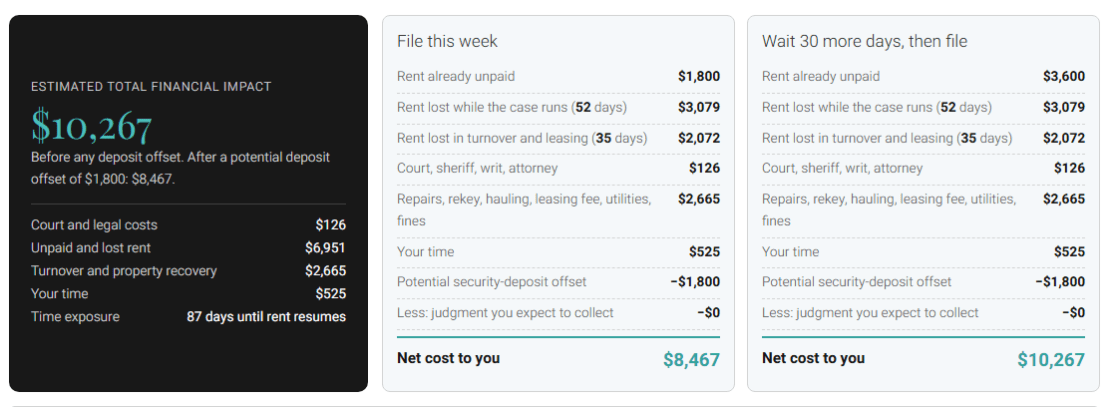
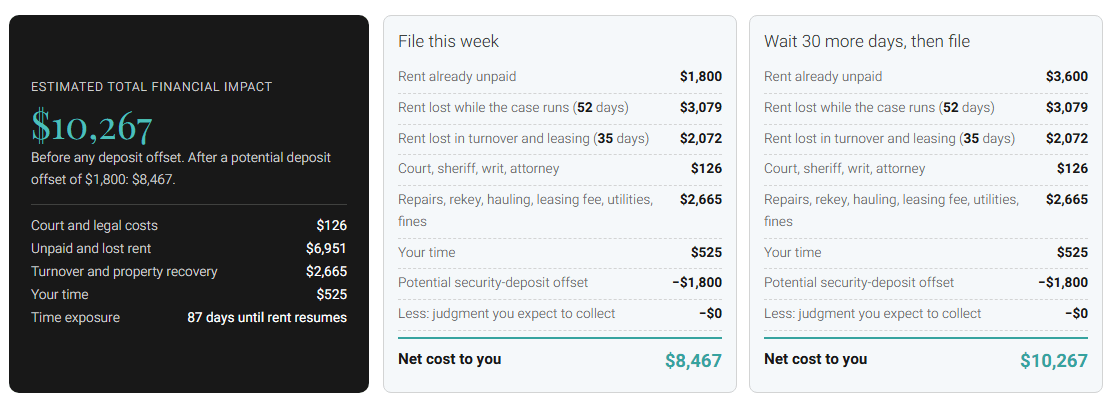
The same eviction, filed this week versus 30 days later, from the QCMS North Carolina eviction cost calculator.
Protect your cash flow before you need courtroom 2330
Most of the evictions I see did not come out of nowhere. They came from waiting too long, a thin file, or a screening process that let the wrong application through.
Our North Carolina eviction cost calculator will add up what a non-paying tenant costs you. The better plan is a tenant who pays on time and follows the lease. That is why Queen City Management Services (QCMS) backs its screening with a 6-Month Tenant Replacement Guarantee: if a tenant we place leaves or is evicted within the first six months, we re-lease your property free. No second placement fee.
Whether you have a non-paying tenant right now or want to look at your portfolio before something goes wrong, you do not have to guess what your rental should earn or what an eviction would cost you.
Run your numbers: Try the free North Carolina eviction cost calculator
Get a professional opinion: Request your free rental and risk analysis
Speak directly with our Charlotte team: call (704) 941-4557 to talk through your property.
Sources
- Queen City Management Services (QCMS) analysis of Mecklenburg County Clerk of Superior Court summary ejectment hearing records, courtrooms 2310, 2330, 2350 and 2370, hearings dated August 3 through September 4, 2026 (pulled September 5, 2026). Plaintiff type estimated from the name on the case.
- Mecklenburg County, 2025 State of Housing Instability & Homelessness Report, Key Findings (52,625 eviction filings in FY2025; 66 percent resulted in an eviction order granted in whole or in part)
- UNC Charlotte Urban Institute for the Housing Advisory Board of Charlotte-Mecklenburg, Charlotte-Mecklenburg Evictions Part 3: One-month snapshot of eviction court records (2018; 1,940 summary ejectment cases with a July 2016 trial date)
- North Carolina Judicial Branch, Court Costs and Fees Chart, Civil, effective January 1, 2025 (N.C.G.S. §§ 7A-305, 7A-311)
- N.C.G.S. § 42-3, § 42-25.6, § 42-28, § 42-34, § 42-36.2, § 7A-228 (North Carolina General Assembly)
- Canopy MLS, Charlotte region and Mecklenburg County lease data, twelve months ending May 2026 (average lease $2,203 per month)
About the Author
Halah Kablan Ladson is Broker-In-Charge of Queen City Management Services (QCMS) in Charlotte, North Carolina, licensed in North Carolina and South Carolina. She has 22 years of real estate experience across four states and founded the firm in 2013. NC License No. 272964 · SC License No. 107533 · NC Firm No. C24768. Connect with Halah on LinkedIn: linkedin.com/in/halah
Images